
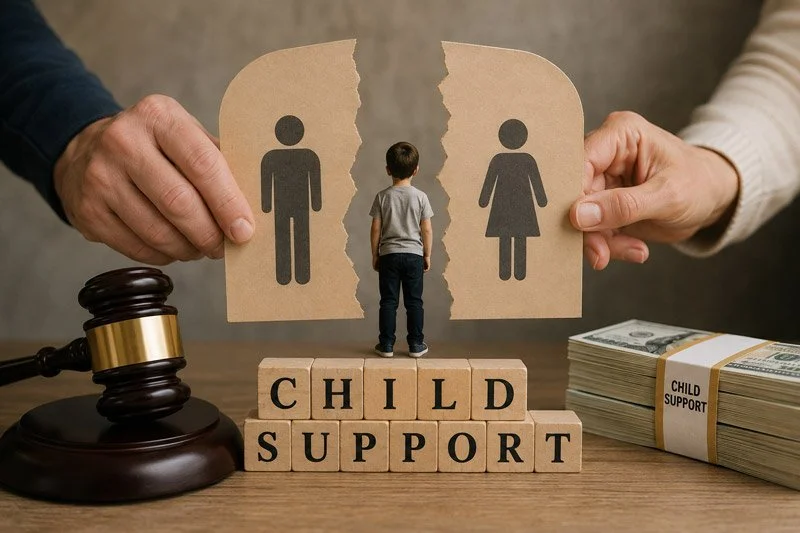
When calculating child support in San Diego, California, the court considers both parents' income to ensure children benefit from their parents' standard of living.
What counts as "income" for California child support purposes?
California Family Code section 4058 defines annual gross income broadly as "income from whatever source derived." County of San Diego v. P.B., 55 Cal. App. 5th 1058 The statute provides a non-exclusive list that includes commissions, salaries, wages, bonuses, rents, dividends, pensions, interest, trust income, annuities, workers' compensation benefits, unemployment insurance benefits, disability insurance benefits, social security benefits, and spousal support actually received from a person not a party to the child support proceeding. County of San Diego v. P.B., 55 Cal. App. 5th 1058
Because this list is non-exclusive, courts have discretion to consider other forms of monetary benefit when calculating child support.
Are cash gifts and inheritances automatically considered income?
No. Cash gifts and inheritances are not automatically treated as income for child support purposes, but they are not automatically excluded either. The key question is whether the funds represent a "recurrent monetary benefit" similar to traditional income. Kevin Q. v. Lauren W., 195 Cal. App. 4th 633, County of San Diego v. P.B., 55 Cal. App. 5th 1058
California courts have held that "nothing in the law prohibits considering gifts to be income for purposes of child support so long as the gifts bear a reasonable relationship to the traditional meaning of income as a recurrent monetary benefit." Kevin Q. v. Lauren W., 195 Cal. App. 4th 633, County of San Diego v. P.B., 55 Cal. App. 5th 1058 However, "while regular gifts of cash may fairly represent income, that might not always be so. Therefore, the question of whether gifts should be considered income for purposes of the child support calculation is one that must be left to the discretion of the trial court." In re Marriage of Williamson, 226 Cal. App. 4th 1303
Who has the burden of proving that a cash deposit is a gift or inheritance rather than income?
The recipient parent bears the responsibility of proving that funds appearing in bank accounts are gifts or inheritances rather than part of their annual gross income. If a parent receives a one-time cash gift or inheritance, they should provide evidence showing it is a sporadic occurrence and not part of their regular income stream.
Will the court count a one-time inheritance as income?
Generally, no—but there are important exceptions. An inheritance itself is not automatically counted as income for child support in California. However, courts can consider an inheritance in two key ways:
First, the court may impute income based on investment potential. If you receive a lump-sum inheritance, the court has the authority to "impute" income based on the potential interest earnings or investment returns that money could reasonably generate if invested. This prevents the entire inheritance from being treated as immediate income while ensuring that the ongoing benefit from the inheritance is reflected in the child support calculation.
Second, an inheritance can be used to satisfy past-due child support. If you already owe child support arrears, an inheritance can be used to pay those debts. California law provides strong enforcement powers to ensure children receive the support they are owed, and lump sums such as inheritances may be subject to liens or garnishment to collect unpaid support obligations.
While the inheritance principal is not automatically factored into child support as current income, the court can use it to ensure child support obligations are met. How the funds are treated depends on whether the inheritance is a one-time windfall, a source of ongoing benefit through investment returns, or an available asset to cover unpaid support.
What about regular cash gifts from family or friends?
A pattern of regular cash gifts may be treated differently than a one-time windfall. If one parent receives cash gifts consistently—such as a yearly deposit of the same amount or monthly payments over an extended period—the court may consider these recurring gifts as income for child support purposes.
In In re Marriage of Alter, the California Court of Appeal examined whether recurring monthly gifts from a parent's mother could be characterized as income. Kevin Q. v. Lauren W., 195 Cal. App. 4th 633 The father in that case received $6,000 per month from his mother for many years. Anna M. v. Jeffrey E., 7 Cal. App. 5th 439 The court found substantial evidence the payments were gifts, noting there was no evidence the father "ever repaid any of the money." Kevin Q. v. Lauren W., 195 Cal. App. 4th 633
The Alter court concluded that "nothing in the law prohibits considering gifts to be income for purposes of child support so long as the gifts bear a reasonable relationship to the traditional meaning of income as a recurrent monetary benefit." Kevin Q. v. Lauren W., 195 Cal. App. 4th 633 The court found it "irrelevant that there is no legal obligation on the part of the donor to continue making the gifts or that the flow of cash does not appear on the income tax return." Kevin Q. v. Lauren W., 195 Cal. App. 4th 633 As the court explained, "'Few, if any, sources of income are certain to continue unchanged year in and year out. People can lose their jobs, interest rates can fall, business conditions can wipe out profits and dividends.'" Kevin Q. v. Lauren W., 195 Cal. App. 4th 633
When these gifts significantly improve the recipient parent's standard of living, the court can include them in child support calculations to ensure the children share in the financial benefits. Kevin Q. v. Lauren W., 195 Cal. App. 4th 633, Haley v. Antunovich, 76 Cal. App. 5th 923
How do courts distinguish between one-time gifts and recurring gifts?
The critical factor is whether the gifts represent "the traditional concept of income as a recurrent, monetary benefit." In re Marriage of Williamson, 226 Cal. App. 4th 1303
In In re Marriage of Williamson, the court distinguished irregular gifts from recurring income. In re Marriage of Williamson, 226 Cal. App. 4th 1303 In that case, aside from annual tax-free gifts and one large gift, the cash advances from the husband's parents were made upon request, depending upon the family's needs. In some years the couple needed large sums to purchase and renovate homes; in other years they requested little or no assistance. The court found these advances were "irregular and outside 'the traditional concept of income as a recurrent, monetary benefit.'" In re Marriage of Williamson, 226 Cal. App. 4th 1303
By contrast, when gifts arrive on a predictable schedule—monthly, quarterly, or annually—and continue over an extended period, courts are more likely to treat them as income for child support purposes. Kevin Q. v. Lauren W., 195 Cal. App. 4th 633, Anna M. v. Jeffrey E., 7 Cal. App. 5th 439
Can courts prevent parents from manipulating the form of income to avoid child support?
Yes. California courts are cautious not to allow any parent to manipulate the form in which they receive funds to reduce their child support responsibilities. Even if the court decides that certain cash gifts or inheritances do not count as part of a parent's gross income under Family Code section 4058, this does not mean the parent can avoid their child support obligations.
California's guideline child support law is intended to ensure that children benefit from the standard of living of both parents. Cal Fam Code § 4050 Courts have broad authority to examine the actual economic resources available to each parent and to ensure that child support calculations reflect the true financial circumstances of the family.
What should I do if I receive a cash gift or inheritance while paying or receiving child support?
If you are paying child support and receive a cash gift or inheritance, be prepared to provide documentation showing whether it is a one-time occurrence or part of a recurring pattern. Keep records of the source, timing, and nature of the funds. If the gift or inheritance is significant, consult with a family law attorney to understand whether it may affect your child support obligation—either through imputation of investment income or through enforcement against arrears.
If you are receiving child support and learn that the other parent has received a substantial gift or inheritance, you may be able to seek a modification of the child support order if the funds represent a recurring benefit that improves the paying parent's standard of living. An experienced family law attorney can help you evaluate whether a modification is appropriate and how to present the necessary evidence to the court.
Key Takeaways
Cash gifts and inheritances are not automatically income, but they can be considered income if they are recurring and regular. Kevin Q. v. Lauren W., 195 Cal. App. 4th 633, County of San Diego v. P.B., 55 Cal. App. 5th 1058
One-time inheritances are generally not counted as immediate income, but courts may impute income based on the reasonable investment return the inheritance could generate.
Recurring gifts may be treated as income if they bear a reasonable relationship to the traditional meaning of income as a recurrent monetary benefit. Kevin Q. v. Lauren W., 195 Cal. App. 4th 633, In re Marriage of Williamson, 226 Cal. App. 4th 1303
Inheritances can be used to satisfy past-due child support, even if they are not counted as income for ongoing support calculations.
Courts will not allow parents to manipulate income to avoid their support responsibilities. California law ensures that both parents continue to provide financial support for their children, regardless of how they receive money.
Livingstone Law has more than 40-years’ combined experience dealing with support and custody issues. Check out our reviews on Google or Avvo.com. Request a free consultation
